




Solutions

AI Agent Development

Our agents are already running in production. They produce results you can verify against the source, and they are operated like professional systems: evals, monitoring, cost control.

Evals from day one · AWS or GCP · Your runtime, your data

Last updated

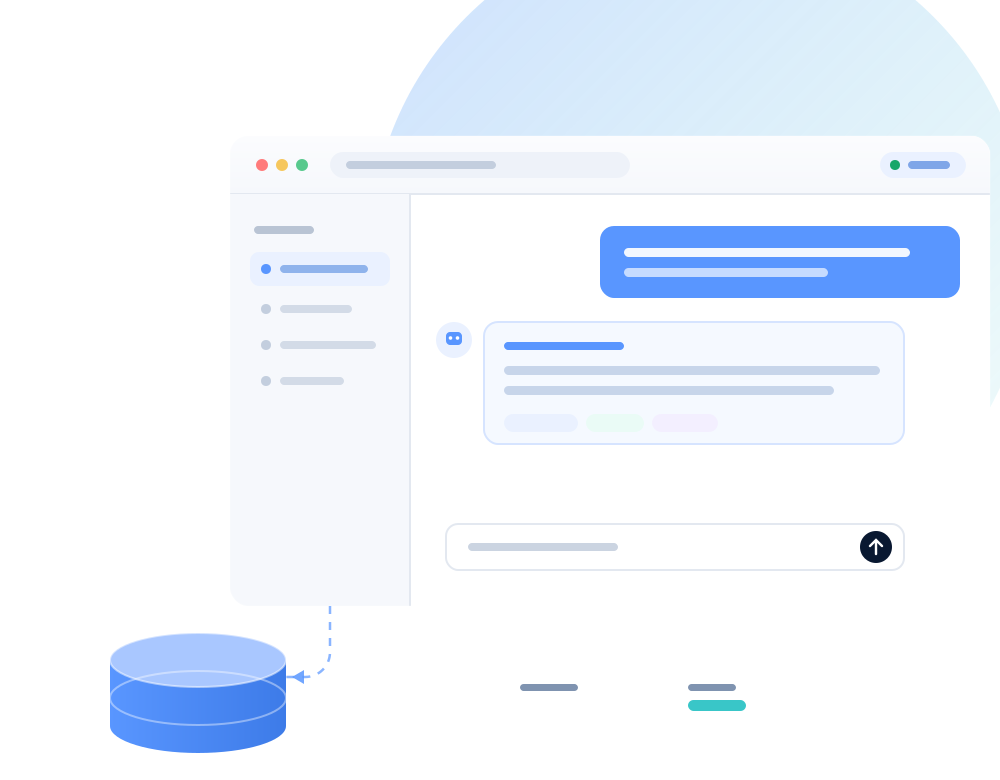
An agent chat thread inside a browser window, with a list of past agent runs down the left side, a database wired to it below, and two telemetry readouts alongside.

Production, not demos

The demo is the easy part.

Most agent projects die between the demo and the first real users, who need the same question answered the same way every time. They need results they can verify against the source and change when the business changes, and that gap is the engineering we do.

  • Auditable by default

    Every tool call, source and agent decision stays traceable.

  • Measured before launch

    Golden datasets and eval suites gate changes before production.

  • Operated like software

    Latency, token cost, failures and drift are visible to your team.

Arctus reporting agent

An analyst asks Arctus in plain language to build a monthly report across all channels with week-over-week trends. The agent assembles the report section by section, writes the insight next to each chart, and exposes the underlying JSON query behind any of them for inspection. Arctus plugs into any data source to generate insights, reports and the workflows they trigger.

Footage from Arctus, our white-label reporting technology. It is where our tooling gets hardened before it reaches client work.

The stack we build on

Proven platforms, wired together by us.

Appliscale builds on Mastra for typed tools, workflows, memory and evals, and on Langfuse for traces, token spend and latency per workflow. Claude and OpenAI are swapped in per task, so no single vendor owns the system, and the agents themselves run in your own AWS or Google Cloud account. Framework, observability, models and cloud: every part is one your team can staff, audit and take over.

  • Agent framework

    Mastra logo

    Typed tools, workflows, memory and evals in one TypeScript framework.

  • Observability

    Langfuse logo

    Traces, token spend and latency per workflow, plus eval runs.

  • Model platform

    Anthropic logo

    Claude for the frontier reasoning steps of a workflow.

  • Model platform

    OpenAI logo

    Swapped in per task, so no single vendor owns the system.

  • Cloud

    AWS logo

    Advanced Tier Services Partner. Agents run in your own account.

  • Cloud

    Google Cloud logo

    The same deployment model when your data already lives in GCP.

What we build

We deliver the complete professional harness around the LLM.

The model is one component. Everything that makes it dependable is engineering, so Appliscale builds the foundation first: typed agent tools over your APIs and databases, and MCP servers that expose your internal systems. Memory systems, multi-agent workflows and model routing sit on top, and evals against golden datasets, Langfuse observability and context engineering keep every change safe to ship.

Foundation

  • Agent tools

    Typed toolkits over your APIs, databases and metrics.

  • MCP servers

    Your internal systems exposed to any MCP-capable agent or IDE.

  • APIs and data

    The integration work that makes an LLM useful against real systems.

Intelligence

  • Memory systems

    Episodic and semantic memory, so the agent improves across sessions.

  • Skills and workflows

    Multi-agent flows with explicit control, not one hopeful prompt.

  • Model routing

    Cheap steps to small models, hard reasoning to frontier ones.

Operations

  • Evals and datasets

    Golden datasets that gate every prompt, tool or model change.

  • Observability

    Langfuse traces plus Mastra monitoring, per workflow.

  • Cost and latency

    Context engineering that cuts spend and response time together.

Reliability engineering

Quality, cost and latency are one system.

Optimising one lever in isolation creates surprises elsewhere, so Appliscale measures the whole runtime rather than any single number. Evals for task success and groundedness run on every change, against golden datasets curated before launch. Token cost stays visible per workflow and per user, latency is traced to the tool or model responsible, and observability covers prompts, tools, memory and errors.

The right question is not "which model?" It is "what do we need to trust this workflow?"

Production readiness

Measured
  • Evals

    Task success and groundedness, run on every change.

  • Golden datasets

    Representative cases curated before launch.

  • Token cost

    Spend visible per workflow and per user.

  • Latency

    Slow steps traced to the tool or model responsible.

  • Observability

    Prompts, tools, memory and errors, all traced.

How an engagement runs

From audit to on-call, without a handoff gap.

Appliscale runs an agent engagement in four stages: an automation audit that ranks your workflows by what agents can automate cheaply, a scoped pilot with a golden dataset and an eval suite, production hardening with monitoring, cost controls and a security review, and monitored operation on Langfuse dashboards behind eval regression gates. Mastra goes in where it fits, Claude or OpenAI behind it, and the agent deploys into your own AWS or GCP account.

  1. 01

    Automation audit

    We map your workflows and identify what agents can automate cheaply, with cost and effort estimates per candidate.

    Output: a ranked candidate list

  2. 02

    Pilot with evals

    One scoped agent, a golden dataset, an eval suite. You see measured accuracy before committing further.

    Output: measured accuracy

  3. 03

    Production hardening

    Monitoring, error handling, cost controls, security review, deployment into your AWS or GCP account.

    Output: an agent live in your cloud

  4. 04

    Monitored operation

    Langfuse dashboards, eval regression gates, and iteration on tools and memory as usage grows.

    Output: no silent regressions

Each phase has a stop condition: audit before pilot, measured accuracy before hardening, hardening before anything carries production load.

Shipped and measured

Agents Appliscale has put into production

Harmonyze came to Appliscale as a legal and compliance vendor and left with an AI teammate that returned a 10x ROI on their contract and compliance work. Retrieval-augmented generation grounded every answer in the client's own documents, on AWS with Next.js, Node.js and LangChain over OpenAI on Azure. The engineering survived a full product pivot: as of August 2026 Harmonyze reports a 5 to 13 percent same-store sales improvement against control groups, a 90 percent cut in coaching prep time, and more than 200 integrations into the systems its franchise brands already run.

For Ingenimax we delivered a production-grade MVP of StarOps, an agent-driven cloud-native delivery platform, into customer pilots within months rather than years. Three agent workflows run in production at Bedrock Platform.

10x
ROI on the Harmonyze AI teammate
200+
Integrations behind one agent
3
Agent workflows in production at Bedrock

What we measure before an agent carries load

Every agent ships with an eval suite and a golden dataset, and with Langfuse instrumentation that makes token spend and latency visible per workflow rather than per invoice. Context engineering, controlling what enters the model's window at each step, is where accuracy, spend and response time move together, which is why Appliscale treats quality, cost and latency as one system rather than three.

Frequently asked questions

The questions engineering leaders ask first.

Clear answers before a discovery call.

What framework do you use to build AI agents?

Our default is Mastra, a TypeScript agent framework we adopted early and know deeply. We have also built custom harnesses and LLM SDKs where a framework did not fit. Our systems blend and swap models across OpenAI, Anthropic and Google, so you are never locked to one provider.

How do you keep token costs and hallucinations under control?

Every agent we ship is instrumented with Langfuse and Mastra internal monitoring, so token spend and reliability are visible per workflow, not just per invoice. We apply context engineering, controlling what enters the model's window at each step, which improves accuracy while lowering spend and latency. Evals against golden datasets catch regressions before users do.

Can you deploy agents inside our AWS or GCP account?

Yes, that is our standard model. We deploy into client-owned AWS and GCP accounts, so nothing sensitive leaves your infrastructure and your team owns the runtime from day one. As an AWS Advanced Tier Services Partner we handle the account-level setup, IAM and networking included.

Do you build evals and golden datasets for existing agents?

Yes. We have built golden datasets and eval suites for our own products and for client systems, including agents we did not originally write. An eval suite is usually the first thing we add during an audit, because you cannot harden or extend an agent you cannot measure.

How long until an agent is in production?

It depends on integration surface, but our track record is months, not years. We delivered a production-grade MVP of StarOps, an agent-driven cloud delivery platform, into customer pilots within months. A scoped pilot with evals typically lands within the first few weeks of an engagement.

Got something hard to ship?

Bidders, multiplayer infra, agentic platforms, or all three, tell us what you're building.