A partner that has run production for 11 years
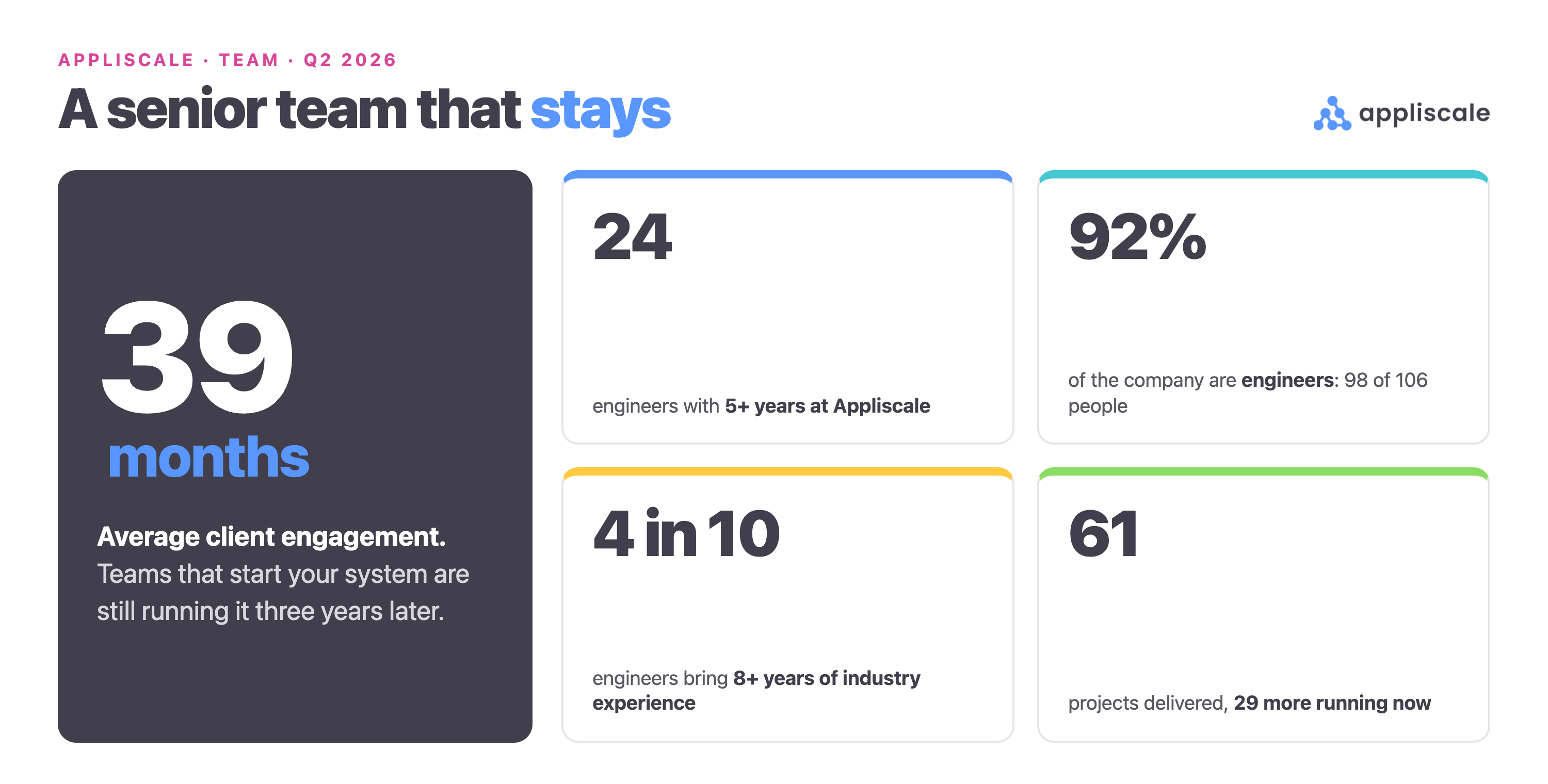
Appliscale has been building and operating production systems since 2015. As of mid-2026 the team is 106 people, 98 of them engineers, across 61 delivered projects with 29 more running now, from engineering hubs in Poland and Ireland.
The number that matters most to a CTO is 39 months: the average client engagement. The team that starts your system is still running it three years later. That continuity compounds: 24 of our engineers have been with Appliscale for five years or more, and 4 in 10 bring 8+ years of industry experience.
Tenure matters because you are not hiring people who learned distributed systems from blog posts. You get engineers who have carried pagers, not just laptops: teams that have debugged Erlang messaging services at 4 million concurrent users and kept a 300,000 requests per minute authorization path alive during a live migration.
A hiring bar built for embedding in your organization
We hire for one profile: proactive engineers who work as team members inside a client organization, not ticket processors behind a wall. Every hire is screened for the communication habits Western European and US companies expect: direct feedback, pushing back on unclear requirements, and raising risks before they become incidents. Our recruitment process is deliberately selective, and we keep refining it for candidate quality rather than throughput.
Once hired, engineers enter a streamlined onboarding built on internal mentoring and structured knowledge sharing. The practical effect for you: when a new engineer joins a project where Appliscale already has a team, they are productive within days, because the context, the runbooks and a mentor who knows your system are already in place. Scaling a team up does not reset its velocity.
We source from the local market we know best: the majority of the team is in Krakow, one of Europe's strongest tech hubs, home to AGH University and Jagiellonian University and a deep pool of senior distributed-systems engineers. We hire people we can meet, mentor and keep, which is how 24 engineers end up staying five years or more.
AI-native delivery without the quality tax
Our product engineers use AI leverage at every step, with human review at every step. Engineers pick the stack, so the model generates code inside proven frameworks instead of improvising. The result is a deliberately small codebase that stays maintainable after the sprint ends.
The time engineers no longer spend on routine coding goes into breaking down requirements, deployment, and security. They also take larger chunks of work, which removes the overhead a traditional team spends slicing tasks and reporting progress. We are working toward Anthropic's Claude partner status. Full detail on the process is on the agentic software factory page.
Cloud cost optimisation with receipts
Cost work only counts if you can show the invoice. Across six engagements we have documented:
The data lake case is representative of the method: instead of renegotiating a third-party contract, we rebuilt the pipeline on MSK, ECS with autoscaling, S3, Glue, and Athena, processing 3 TB of data daily at 2% of the quoted price. More on our pipeline work is on the Data Engineering page.
Observability and reliability engineering
We design telemetry pipelines that control cost at the source: standardised tags, ownership metadata on every metric so incidents route to the right team fast, and collector-level filtering before data hits a paid backend. For one client we unified monitoring on Datadog with standardised dashboards and Universal Service Metrics, cutting roughly $100K per month on log costs alone while improving alert accuracy.
We have seen a single unreviewed integration at a large global gaming company trend toward six-figure annual cost, and individual bad tags cost tens of thousands of dollars per week. Governance is not optional at scale. Details on the Telemetry & Observability page.
Legacy modernisation that ships
Three engagements show the range. A public-facing TypeScript authorization service, riddled with vulnerable dependencies, migrated in phases to Kotlin and Spring Boot while serving over 300,000 requests per minute at peak. A Groovy (Grails) monolith decomposed into Go microservices in six months, deployed on EKS with ArgoCD and Terraform, with end-to-end tests as delivery milestones. And a codebase its owners considered unmaintainable, rebuilt into a product that carried the company to an $80M acquisition.
The common thread: contracts between old and new defined up front, migration in small verified batches, and no big-bang cutover.
Staff extension with senior engineers
We extend your team with units that take whole subsystems, not tickets. A team owns a service end to end: architecture, implementation, tests, deployment, monitoring, on-call. You review milestones, not pull-request queues. For a European legal-tech vendor, that model took a matter management platform from zero to an MVP that won 10+ new US and EU customers within 12 months of launch.
We are an AWS Advanced Tier Services Partner and partner with Datadog and Databricks. Engineering is polyglot: Go, Kotlin, Java, TypeScript, Python, Erlang, and Elixir, on AWS and GCP with Kubernetes and Terraform. We also serve deep verticals, including gaming technology.
Talk to an engineer


