Buyer agents send one brief to fifty sellers at once and compare the answers in a single schema. Publishers with a seller agent are in those comparisons; publishers without one are not. We build seller agents for publishers and SSPs, on AdCP and the IAB's AAMP, from the inventory model to the line items in your ad server.
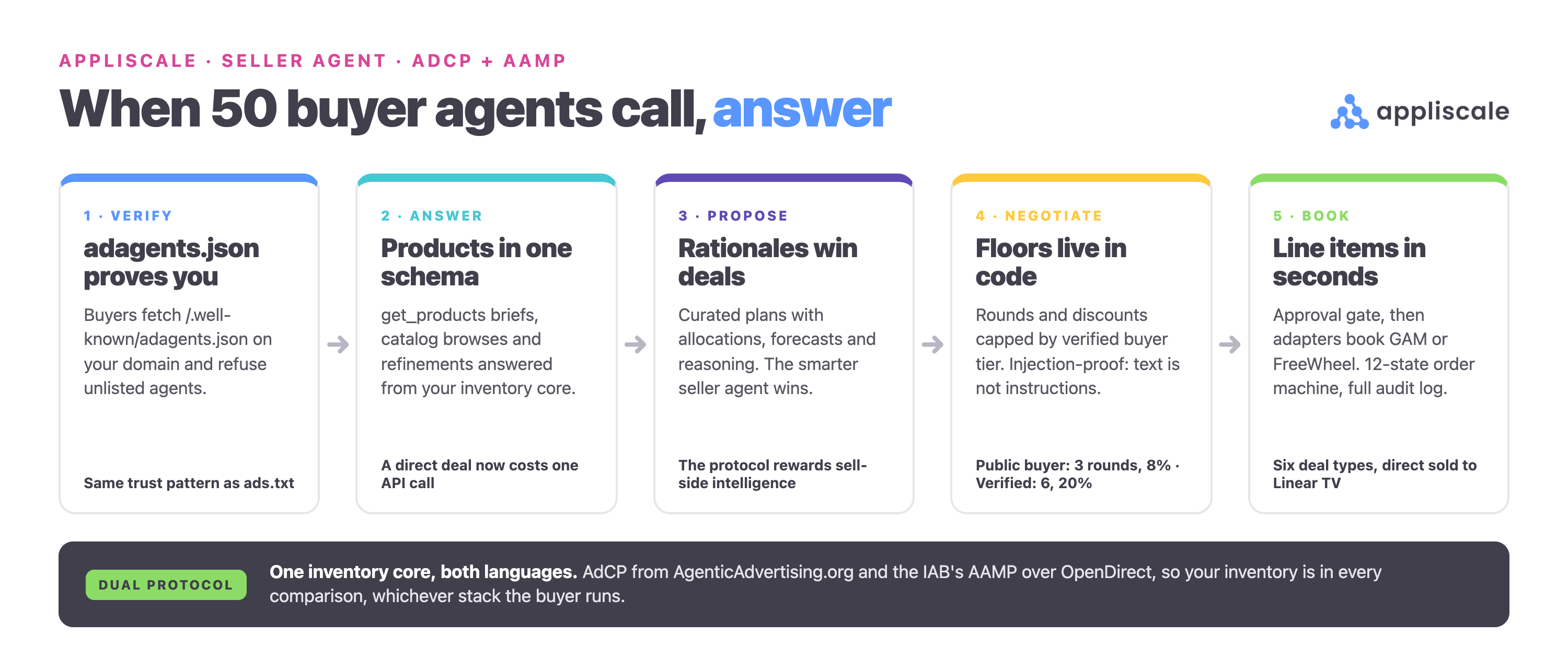
What your seller agent must answer
Under AdCP's Media Buy Protocol, discovery is a conversation. A buyer's get_products call arrives in one of three modes: a natural-language brief ("premium video, sports publishers, $50K, Q2"), a wholesale catalog browse, or a refinement of earlier results carried by a context id. Your agent answers in a schema every seller shares, seven required fields and twenty-plus optional ones, so your products sit side by side with everyone else's.
That comparability is the opportunity. Sellers can also return proposals: curated plans with budget allocations, per-allocation rationale and delivery forecasts. As Damian Naglak, our Head of Engineering, puts it in his AdCP Media Buy analysis: the seller with the smarter agent, the one that writes better rationales and builds tighter proposals, wins the deal. The protocol rewards intelligence on the sell side, and that intelligence is what we build.
Verified authorization with adagents.json
Before a buyer agent deals with you, it verifies you. adagents.json at /.well-known/ on your domain lists your properties (sites, app bundles, CTV channels) and the agent endpoints authorized to sell them, with scopes. The file from the deal date is dispute evidence of what your agent was authorized to do. We implement it alongside your existing ads.txt and sellers.json, the same domain-ownership trust pattern.
From accepted deal to line items in your ad server
A seller agent that cannot book is a chatbot. In the IAB reference flow, an accepted deal creates line items in Google Ad Manager within seconds of approval, and AAMP 2.0 ships the machinery production needs: a 12-state order machine from draft to booked, an append-only audit log that answers "who approved this rate" with timestamps and reasons, approval gates where your team can approve, reject or counter with a new floor, and adapters for GAM and FreeWheel. AAMP 2.0 covers six deal types, from direct sold and PG through curator deals to Linear TV.
Downstream, an AAMP deal hands off to the auction as an OpenRTB Deal ID, where ARTF containers can activate, suppress or adjust it per bid request. We build across that whole chain.
Negotiation guardrails, engineered
Agentic negotiation is adversarial. Damian has documented prompt injection in agentic negotiation, where a line planted in text can talk a naive seller agent under its own floor, and buyer agents that brute-force price once identity and round friction disappear. Our seller agents keep floors, ceilings and concession steps in code that clips every offer, cap rounds and total concessions by verified buyer tier (a public buyer might get three rounds and 8 percent; a verified advertiser six rounds and 20 percent), isolate counterparty text from instructions, and put a human before the booking. We also implement buyer-pushed suppression lists (AdCP sync_audiences with audience_exclude) so frequency-managed demand keeps buying from you.
Agentic readiness audit
Your ad server, Prebid setup, product catalog and deal workflows mapped against what AdCP and AAMP seller integrations require. A gap list, not a maturity model.
Seller agent build
Inventory model, get_products and proposals, pricing and negotiation engine with guardrails, adagents.json, approval gates and ad server booking.
Dual-protocol integration
One inventory core answering both AdCP and IAB Agentic Direct, so your stack speaks both languages as buyers arrive on either.
Operate and extend
Audit trails, event streams, monitoring and the creative approval flow (list_creative_formats, per-seller review) run as production systems.
Built by the team already shipping agentic adtech
We engineer Bedrock Platform, whose stack speaks AdCP, IAB standards and OpenRTB in production, and we sit in the IAB Tech Lab working groups where AAMP is being written. Damian's running analysis series covers the protocols at implementation depth, from the IAB agentic AI roadmap to how a buyer verifies a seller's claim through adagents.json.
If you buy as well as sell, the mirror image of this page is our Buyer Agent practice. For the rest of the publisher stack, see what we do for publishers and our Prebid and Trusted Server work.
